
The Legendary Floating Hotel: A Maritime Story Full of Surprises
Discover the unbelievable journey of The Legendary Floating Hotel: A Maritime Story Full of Surprises. Explore its rise, relocation & final fate in this fascinating maritime story.
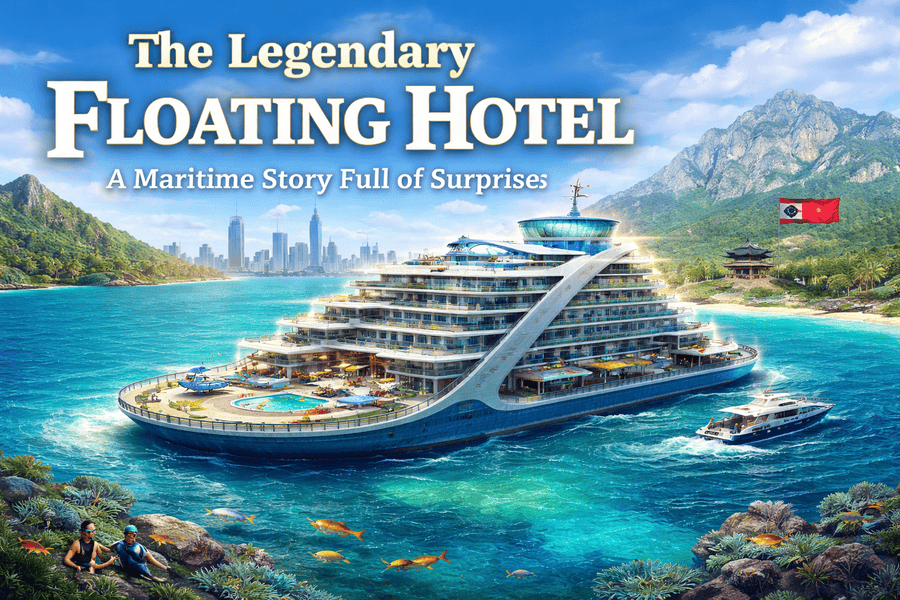
The Legendary Floating Hotel: A Maritime Story Full of Surprises
The history of travel is filled with bold ideas. Some became global success stories. Others faded away quietly. But every once in a while, a dream appears so unique, so daring, that even its failure becomes legendary.
This is the story of the Legendary Floating Hotel — a once-glorious floating hotel that sailed through ambition, adventure, controversy, and finally, an unexpected end.
From the sparkling waters of the Great Barrier Reef to the busy banks of the Saigon River, and later to the secretive shores of North Korea, this maritime marvel lived many lives.
And truly, it earned its place in history.
The Birth of a Bold Dream
Every great story starts with a dreamer.
In the 1980s, a property developer and passionate diver named Doug Tarca had a simple yet powerful question:
“What if people could stay overnight at the reef instead of just visiting for a few hours?”
At the time, tourists would take boats from the coast of Queensland to experience the coral beauty of the Great Barrier Reef, the world’s largest coral reef system. While the day trips were popular, Tarca believed visitors wanted something more immersive.
Originally, he considered buying retired cruise ships and permanently anchoring them near the reef. However, after calculating the costs and considering environmental impact, he made a smarter decision: build a purpose-designed floating resort from scratch.
And so, construction began.
Engineering a Floating Paradise
In 1986, with an investment of approximately 45 million Australian dollars, the dream started becoming reality. The structure was massive — a 10,000-ton vessel built to operate as a stationary hotel.
This wasn’t just a boat with beds. It was a fully functional luxury resort at sea.
It featured:
176 comfortable guest rooms
A full-sized tennis court
A nightclub
Bars and restaurants
Sun decks with breathtaking ocean views
The design itself was dramatic, rising above the sea like a modern architectural wave. It quickly earned attention as the world’s first purpose-built floating hotel near a natural wonder.
When it opened, guests could travel by catamaran or even helicopter for a premium experience. The idea felt futuristic. Imagine waking up surrounded by turquoise waters, stepping outside, and diving straight into coral paradise.
For a while, it worked.
When Nature Fights Back
However, even the best plans can collide with reality.
The Coral Sea is beautiful — but it can also be unpredictable. Strong winds and rough waves frequently disrupted transport services. Boats were delayed. Helicopters were grounded. Guests were sometimes stranded.
Seasickness became a serious issue.
One former guest reportedly joked that the ocean moved more than the dance floor in the nightclub. While humorous, it highlighted a real challenge: not everyone enjoys constant motion beneath their feet.
Gradually, bookings declined. Operating costs remained high. Within a year, the ambitious project struggled financially.
Eventually, the difficult decision was made to close and sell the property.
But here’s the twist: because it floated, it could go anywhere.
A New Beginning in Vietnam
After being sold, the hotel was towed thousands of miles across the ocean to Ho Chi Minh City in Vietnam.
Now renamed the Saigon Floating Hotel, it was permanently docked along the Saigon River.
Interestingly, this new chapter proved far more stable — literally and financially. Without open-sea waves, the structure became a vibrant social hotspot. Locals and tourists flocked to its bars and nightlife venues.
It became famous for its lively atmosphere and earned the nickname “The Floater.” For nearly a decade, it operated successfully.
This phase teaches an important lesson in business and innovation:
Sometimes success isn’t about changing the product — it’s about changing the location.
However, its journey was far from over.
The Strangest Twist: North Korea
In the late 1990s, the floating hotel was sold again — this time to the government of North Korea.
Yes, North Korea.
The hotel was relocated to the Mount Kumgang Tourist Region, part of a rare joint tourism project between North and South Korea.
This was historic. The two countries, technically still at war since the Korean War, were collaborating on a tourism zone to encourage reconciliation and economic cooperation.
Between 1998 and 2008, more than one million South Korean tourists crossed the border to visit Mount Kumgang. Many stayed at the renamed Hotel Haegumgang, the same floating structure that once welcomed divers near the Great Barrier Reef.
For a moment, it symbolized hope.
A Sudden and Tragic Halt
Then, tragedy struck.
In 2008, a South Korean tourist was fatally shot by North Korean security forces after allegedly wandering outside the designated tourism zone. The incident immediately suspended the project.
Tourism stopped overnight.
The floating hotel remained docked but largely unused. Reports suggest it was occasionally used for government officials and military events.
Still, the days of international guests and lively nightlife were over.
The Final Chapter
Years later, in 2019, North Korean leader Kim Jong-un visited the Mount Kumgang site. According to state media, he criticized the condition of the facilities, calling them outdated and shabby.
Soon after, he reportedly ordered the floating hotel to be dismantled.
After three decades of movement across continents and political systems, the once-iconic Legendary Floating Hotel was reduced to scrap metal.
Its journey had finally ended.
Why the Legendary Floating Hotel Still Matters
You might wonder: why does this story still capture attention?
Because it represents:
Bold entrepreneurship
Creative maritime engineering
The risks of tourism innovation
The unpredictable power of political decisions
The impact of natural forces
It is a case study in ambition, adaptation, and global movement.
Step-by-Step Guide: Lessons from the Floating Hotel’s Rise and Fall
If you're an entrepreneur, developer, or tourism investor, here’s what you can learn:
1. Validate the Environment
Before launching a major project, deeply study natural conditions. Weather patterns, ocean currents, and accessibility can make or break a venture.
2. Plan for Logistics
A beautiful destination means little if guests struggle to reach it. Transport reliability is critical in hospitality businesses.
3. Adapt Quickly
When the hotel moved to Vietnam, it thrived. Sometimes relocation or repositioning saves an investment.
4. Understand Political Risk
Operating in politically sensitive regions carries uncertainty. Changes in policy or diplomatic relations can instantly halt operations.
5. Maintenance Matters
A structure, especially in marine environments, requires continuous care. Saltwater corrosion is relentless.
Anecdote: A Diver’s Dream
Imagine Doug Tarca standing on the deck during the hotel’s opening week. The sun setting over the reef. Guests laughing. Helicopter blades fading in the distance.
For a moment, the dream was real.
Even if the business struggled, even if it moved continents, even if it ended in dismantlement — that vision existed. And that alone is powerful.
Great innovations are rarely smooth journeys.
The Bigger Picture: Floating Hotels in Modern Tourism
Today, the idea of a floating hotel no longer sounds strange. In fact, it has evolved into:
Floating eco-resorts
Cruise-based luxury residences
Sustainable marine architecture projects
Modern floating hotels now integrate renewable energy, coral protection strategies, and environmental sustainability.
In many ways, the Legendary Floating Hotel was ahead of its time.
Maritime Innovation and Risk
Marine construction projects face unique challenges:
Saltwater corrosion
High maintenance costs
Environmental regulations
Transport logistics
Insurance risks
Yet they also offer unmatched appeal — being surrounded by water brings a sense of escape and exclusivity that land-based resorts can’t replicate.
That balance between risk and reward defined the floating hotel’s journey.
A Story That Refuses to Sink
Even though the physical structure no longer exists, its legacy floats on.
Travel historians reference it as one of the most unusual experiments in luxury tourism. Business analysts study it as a case of bold innovation meeting harsh reality. Political observers see it as a symbol of rare inter-Korean cooperation.
And storytellers? They simply see a fascinating tale.
Because how often does one hotel:
Begin near a natural wonder,
Thrive in Southeast Asia,
Become part of geopolitical diplomacy,
And end in authoritarian restructuring?
Not often.
Exploreroamer Thoughts
The Legendary Floating Hotel was more than steel and concrete. It was a dream carried by waves across three countries and countless headlines.
It reminds us that innovation requires courage. That risk is part of ambition. And that sometimes, even when a project ends, its story continues.
In a world where new travel trends appear every year, few can match the dramatic, globe-crossing life of this remarkable floating hotel.
It may have been dismantled, but its legacy remains anchored in maritime history — a bold reminder that even dreams built on water can leave a permanent mark on land.
Discover destinations, travel tips, and border-free adventures at Exploreroamer.com 🌍
Recommended Stories:
Curacao Beyond the Blue: 2026 Travel Trends, Resorts & Local Experiences | Exploreroamer
Pakistan passport rises Feb 2026: Updated list of 32 visa-free destinations
Limited-Time Travel Perk: TSA PreCheck Enrollment Opportunity at Waterloo Regional Airport
Dubai Travel Alert: Why Some “Too-Good” Holiday Deals Aren’t What They Seem
World’s Fastest ‘Flying Train’: Inside the Ultra-Speed Journey Operating in Just Two Countries
We’d love to hear from you!
Whether you have a question, suggestion, or want to collaborate — feel free to reach out.
info@exploreroamer.com
© 2025. All rights reserved.
Join Our Journey
Get travel tips and stories straight to your inbox